

NASA’s Simulated Mars Crew Reaches One Year in Isolation at Houston Habitat
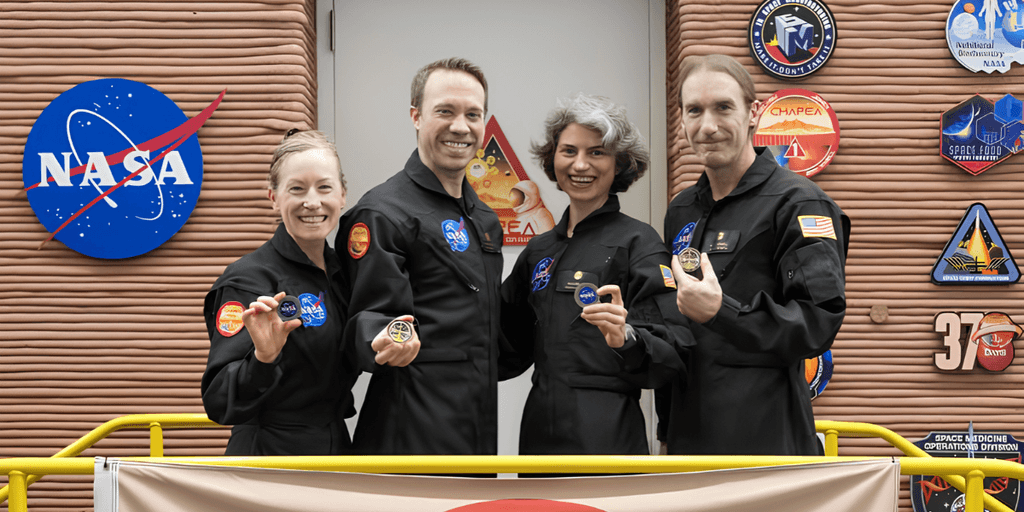
Four crew members have spent a year in a Mars-like habitat, helping researchers study the human challenges of long-duration space exploration.
Four volunteers participating in NASA’s simulated Mars mission have reached a year inside an isolated habitat at the agency’s Johnson Space Center in Houston. The milestone marks a significant stage in the Crew Health and Performance Exploration Analog, known as CHAPEA, which is designed to help researchers understand how people live and work under conditions resembling a long-duration mission to Mars.
The four participants entered the 1,700-square-foot, 3D-printed habitat on October 19, 2025. During their stay, they have followed routines intended to replicate aspects of life on another planet, including managing limited resources, growing crops, conducting research and completing simulated activities on a Martian surface.
The crew consists of mission commander Ross Elder, medical officer Ellen Ellis, science officer Matthew Montgomery and flight engineer James Spicer. Their planned mission lasts 378 days, with the crew scheduled to leave the habitat on October 31.
A Ground-Based Test for Deep-Space Missions
A human mission to Mars would involve challenges that cannot be fully replicated through short training exercises. Astronauts would face prolonged isolation, limited supplies, confined living quarters and substantial communication delays with Earth. NASA’s analog missions allow scientists to examine some of those challenges without sending a crew into space.
The CHAPEA habitat provides a controlled environment in which researchers can observe how participants adapt to demanding routines and limited resources over an extended period. Although the crew remains on Earth, the conditions are designed to simulate selected operational and social pressures expected during a future Mars mission.
The experiment is not a literal simulation of every aspect of Mars travel. Participants do not experience the planet’s actual gravity, radiation exposure or atmosphere. Instead, the program focuses on questions that can be investigated through a ground-based habitat, including crew performance, daily operations and the effects of isolation.
The data may help NASA plan future missions by identifying practical needs for food systems, exercise, medical support and decision-making.
Communication Delays and Crew Independence
Communication is a major concern for missions far from Earth. Depending on the positions of Earth and Mars, a message may take up to about 45 minutes to travel in one direction. This means a question sent to mission control could take a long time to receive a response, making real-time assistance impossible for many routine decisions.
In the CHAPEA mission, communication with families has been limited to email and includes a Mars-like delay. The arrangement gives researchers an opportunity to study how delayed contact affects the crew’s routines, relationships and ability to work independently.
The experience also provides insight into how crews may need to respond to unexpected problems without immediate guidance from Earth. Future astronauts will require procedures and training that allow them to assess situations, prioritize tasks and make decisions when direct support is unavailable.
Researchers can use the findings to improve planning for medical care, operational procedures and communication systems. The objective is to understand how crews can remain productive and healthy while handling the uncertainty and workload of a distant mission.
Everyday Tasks Become Research Opportunities
The habitat’s daily activities provide researchers with information about the practical demands of extended missions. Managing food, maintaining equipment, exercising and completing scientific work all compete for limited time and resources.
Growing crops and managing supplies can help researchers examine how crews might sustain themselves when resupply opportunities are limited. Simulated spacewalks and geological activities allow participants to practice procedures and provide opportunities to study how work is performed in a constrained environment.
The crew’s experience is also relevant to physical and psychological health. Living for a year in a confined space can place demands on sleep, exercise, privacy, teamwork and conflict management. Small issues that are manageable during a short mission may become more consequential when people must continue working together over many months.
NASA’s researchers will analyze information collected during the mission alongside physiological, psychological and performance measures. The aim is to identify methods that help crews maintain health, make sound decisions and complete objectives under sustained pressure.
What Happens After the Mission
After the crew leaves the habitat, NASA plans to conduct post-mission evaluations and debriefings. Those activities will allow researchers to compare the crew’s experience with the conditions and goals established before the mission began.
The data will not, by itself, determine whether a human mission to Mars is ready to proceed. Space exploration requires advances across multiple areas, including propulsion, life support, radiation protection, transportation, landing systems and surface operations. Human-performance research is one component of that broader preparation.
The findings may nevertheless help inform the design of future habitats and the routines that astronauts follow during long missions. They may also provide information relevant to extended operations on the Moon, where crews could face isolation, limited supplies and delayed assistance.
The scheduled conclusion of the 378-day mission will give participants an opportunity to reconnect with their families in person after a year of restricted contact. Researchers will then examine what the experience reveals about living and working in an isolated environment for an extended period.
The one-year milestone underscores a central challenge of human exploration beyond Earth: successful missions will depend not only on spacecraft and technology, but also on the people who must operate them. By studying those demands on the ground, NASA is building evidence that could help future crews remain safe, capable and connected during journeys far beyond Earth.

Good Morning US Contributor
Covers world affairs and science, connecting research and foreign policy to the readers they affect.
This article features partner, contributor, or branded content from a third party. Members of the Good Morning US editorial staff were not involved in the creation of this content. All views and opinions are those of the contributor alone.
You May Also Like

Memorra: Best AI Powered Memory Preservation Service in the USA of 2026

How ORYN Quest Uses AI to Help Parents Discover Kids’ Activities and Support Their Growth

Kranay Academy Is Taking the Guesswork Out of Scholarships With 3 FREE Personalized Matches

Chris Gibson: America's Holistic Esthetician

Denise Janette Bruneau Writes Hope Into Love