

Oregon Seafood Plant Fire Triggers Evacuations After Ammonia Leak on Newport Bayfront
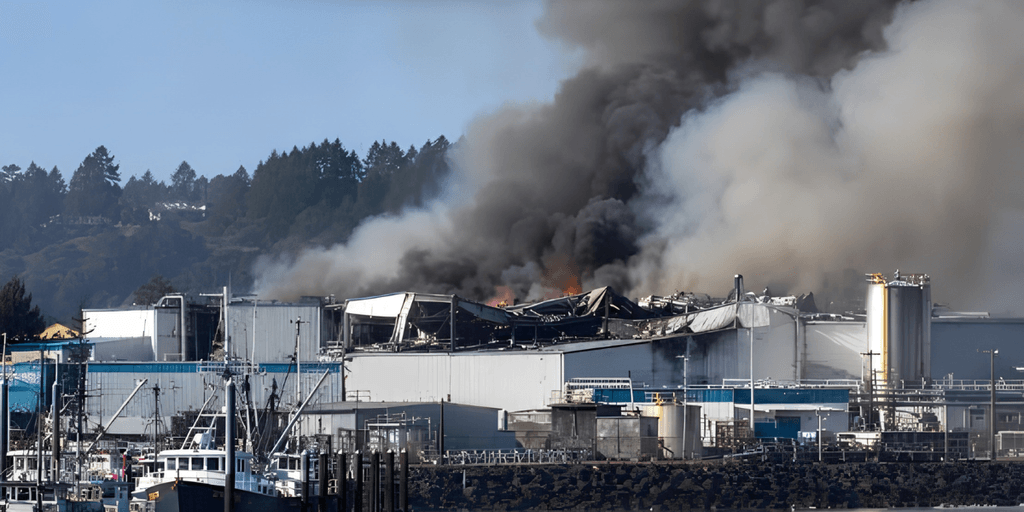
Crews responded to a major fire in Newport, Oregon, forcing nearby evacuations over ammonia smoke concerns.
A fire at a Pacific Seafood processing plant on Newport’s Bayfront prompted evacuations within a one-mile area on October 25 after the incident released ammonia into the air and caused part of the building’s roof to collapse. Authorities closed access to the commercial waterfront as firefighters and hazardous-materials teams worked to control the blaze and assess potential exposure risks.
The fire broke out at the plant at 245 Southeast Bay Boulevard. Emergency responders from departments across Lincoln County arrived as smoke spread through the area. The Oregon State Fire Marshal sent a regional hazardous-materials team to assist with the response.
City officials ordered residents and businesses within a mile of the facility to evacuate, including Port of Newport facilities, a recreational vehicle park and marina on the south side of Yaquina Bay. The Hatfield Marine Science Center also closed during the emergency.
Officials said no injuries had been reported in the initial response, and the company stated that all employees were accounted for. The situation remained active as emergency crews worked to manage the fire and the possible chemical hazard.
Evacuations Around the Waterfront
The evacuation order affected homes, businesses and public facilities in and around Newport’s waterfront district. Police blocked entrances to the Bayfront while firefighters directed water onto the burning facility.
The response included establishing a gathering point for evacuees at Sam Case Elementary School. As the evacuation continued, the shelter operation was moved to Atonement Lutheran Church along U.S. Highway 101.
Residents leaving the area had little time to prepare. Some left with phones, keys and essential belongings, while others attempted to gather children and pets before departing. The evacuation demonstrated the practical challenges of responding to an industrial emergency in a populated area where homes, businesses and visitor facilities sit close to the waterfront.
Officials advised residents to remain indoors if they were outside the evacuation zone and to follow instructions from emergency authorities. The concern centered on smoke and the possibility of ammonia contamination, although officials had not immediately established the concentration of ammonia in the air.
The evacuation boundary was intended to reduce exposure while responders assessed conditions. Such boundaries can change as emergency teams learn more about the incident, making official alerts important for people living or working nearby.
Why Ammonia Is a Concern
Ammonia is used in some industrial refrigeration systems, including facilities that process and store food. In concentrated form, it can pose serious health risks, particularly when inhaled or when it comes into contact with the eyes or skin.
The presence of ammonia in smoke from a fire can complicate an emergency response because firefighters must account for both the flames and the potential chemical exposure. Hazardous-materials teams may need specialized equipment to assess the atmosphere, identify contamination risks and determine when an area can safely be reentered.
The actual risk depends on the quantity released, the concentration in the air, weather conditions and the duration of exposure. A report that ammonia is present does not by itself establish the level of danger at every nearby location.
Industrial facilities that use ammonia generally operate under safety and maintenance requirements intended to reduce the likelihood of releases. After a fire, investigators typically need to determine how the incident began, how the building’s systems were affected and whether the release caused additional hazards.
Those questions cannot be answered fully while emergency operations are still underway.
Effects on Newport’s Businesses and Visitors
Newport is a coastal community where commercial fishing, seafood processing, tourism and marine activity contribute to the local economy. An emergency at a waterfront processing facility can therefore affect more than the building itself.
The evacuation closed nearby businesses and restricted access to parts of the Bayfront. Port facilities, marina operations and visitor destinations were among the locations affected by the response.
Temporary closures can disrupt restaurant and retail activity, interfere with deliveries and prevent workers from reaching their jobs. Businesses may also face uncertainty about when they can reopen, particularly if authorities need to inspect buildings or test for contamination before lifting restrictions.
For industrial operations, the incident raises questions about equipment damage, production interruptions and the process of safely restarting operations. The scale of those effects will depend on the extent of damage and the findings of investigators.
Pacific Seafood said it was not aware of injuries among employees and that all workers had been accounted for. The company said its immediate focus was supporting emergency responders and ensuring safety while authorities investigated the circumstances.
Emergency Coordination and Public Safety
The response involved local fire departments, police, city officials and the Oregon State Fire Marshal’s hazardous-materials resources. Coordination is essential in incidents that combine a building fire with a possible chemical release because each hazard requires different equipment and procedures.
Firefighters must control the blaze while avoiding unnecessary exposure. Police and local authorities manage road closures and evacuation instructions, while hazardous-materials specialists assess the chemical risks.
Public communication is equally important. Residents need to know whether they should leave an area, shelter indoors or avoid particular roads. Conflicting information can cause confusion during an emergency, especially when conditions change rapidly.
The evacuation center gave displaced residents a temporary place to gather while the immediate danger was assessed. Such arrangements can be particularly important for families with children, older residents and people who need assistance leaving their homes.
Investigation and Recovery
Once the immediate emergency is under control, investigators will need to determine the cause of the fire and assess the damage to the processing plant. The partial roof collapse may complicate inspection and recovery work, depending on the building’s structural condition.
Authorities will also need to determine whether any environmental cleanup or additional safety checks are required before nearby facilities can reopen. The timing will depend on the fire’s severity, the condition of the structure and the results of any chemical assessments.
For Newport, the incident underscores the challenges of managing industrial hazards in a waterfront district that combines commercial operations, public facilities and residential areas. The immediate priority is protecting people from the fire and potential ammonia exposure, while the longer-term task will be understanding what happened and determining when normal activity can safely resume.

Good Morning US Contributor
Covers national politics and policy, with an eye on how decisions in Washington reach everyday households.
This article features partner, contributor, or branded content from a third party. Members of the Good Morning US editorial staff were not involved in the creation of this content. All views and opinions are those of the contributor alone.
You May Also Like
Memorra: Best AI Powered Memory Preservation Service in the USA of 2026

How ORYN Quest Uses AI to Help Parents Discover Kids’ Activities and Support Their Growth

Kranay Academy Is Taking the Guesswork Out of Scholarships With 3 FREE Personalized Matches

Chris Gibson: America's Holistic Esthetician

Denise Janette Bruneau Writes Hope Into Love