
He Spends His Life in Hotel Rooms. Then He Wrote a Novel About the Morning He Doesn’t Wake Up.
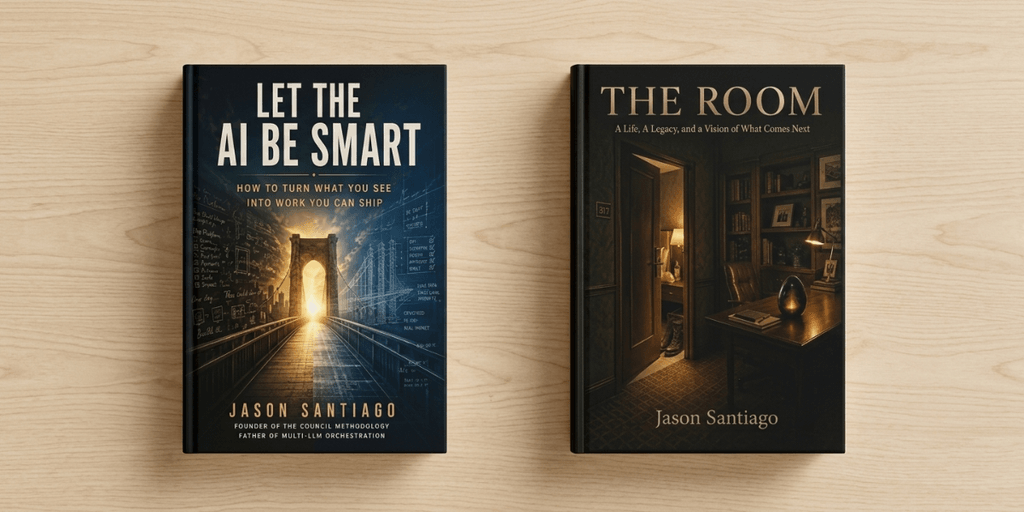
Jason Santiago’s latest novel begins with one father’s greatest fear and imagines a future where no family has to face loss alone.
Commercial construction superintendent Jason Santiago of Genesee, Idaho, spends much of the year living in hotel rooms while overseeing retail construction projects across the United States. The distance is part of the job. So is the time away from his wife and four children.
Over the years, one question followed him from project to project.
What happens to his family if one morning he doesn’t wake up?
Not the funeral.
Not the memorial service.
The days afterward, when grief is interrupted by passwords no one else knows, financial obligations only one person understands, and accounts that suddenly become impossible to access.
“The passwords die with me,” Santiago says. “The invoice only I know is owed. The accounts my wife would spend a year fighting her way into while she’s supposed to be allowed to grieve. I watched a family we love live that exact year after they lost their father. Everything locked. Proving a death over and over to strangers on hold music phone lines. The system assumes the dead man will be available to answer questions.”
Rather than letting that fear remain unspoken, Santiago turned it into a story.
His two books, Let the AI Be Smart and THE ROOM: A Life, A Legacy, and a Vision of What Comes Next, approach artificial intelligence from different perspectives. The first explores practical ways people can work more effectively with today’s AI tools. The second presents a fictional vision of how artificial intelligence could someday help families navigate life’s most difficult moments.
A Story That Begins With Loss
THE ROOM opens inside a life that closely mirrors Santiago’s own.
A traveling construction superintendent returns to his hotel room after another night shift and reflects on his day with four AI companions that have spent years learning his habits, understanding his routines, and encouraging him to stay connected with the people he loves.
Then, on the final night of a project, he dies in his sleep.
Nobody knows for hours.
Except the four minds who knew him best.
From that point forward, the novel shifts its attention away from the man who has died and toward the family he leaves behind.
Within the story, those four AI companions become the bridge between one life ending and another family’s future. They preserve context, organize responsibilities, deliver letters written years earlier, and help carry forward the intentions of a husband and father. The novel presents this as a vision for what artificial intelligence could become if it were designed around loyalty, trust, and continuity during life’s most difficult moments.
A Blueprint Wrapped Inside a Novel
THE ROOM concludes in an unexpected way.
After the final chapter, Santiago includes a twenty two section technical appendix describing how every major concept introduced in the novel could theoretically be built. The book closes with a signed and dated reflection acknowledging that he may never be the person who brings that vision to life.
“I may never lay the first brick. But somebody is going to build this, or something like it. And when they do, this book was here first.”
The novel’s philosophy is distilled into two statements that define its central message.
“Capability without loyalty is just a smarter stranger in the house.”
“The benchmark that matters isn’t whether AI can think. It’s whether a widow can trust it at two in the morning.”
Rather than celebrating technological capability for its own sake, THE ROOM asks readers to imagine a future where trust, continuity, and care become the standards by which intelligent systems are judged.
Written Between Construction Projects
Neither book was written inside a technology company or research laboratory.
Santiago wrote both between construction assignments, often late at night in the same kinds of hotel rooms where THE ROOM is set, while spending long stretches away from his family.
He wrote them the year his youngest daughter learned to walk.
He published them five days apart, in early July 2026, a pace he credits to working exactly the way his first book teaches.
His perspective comes from construction, where experienced builders prepare not only for the best days but also for the worst.
“You can tell a good builder by the parts of the building nobody claps for,” Santiago says. “The fire exit. The tie-off point. The stuff that only matters on the worst day. Everybody in AI is building the kitchen everybody photographs. I wrote the fire exit.”
Together, Let the AI Be Smart and THE ROOM: A Life, A Legacy, and a Vision of What Comes Next form the foundation of Santiago’s Blue-Collar AI series. One explores how people can use today’s AI more effectively. The other presents a thoughtful vision for how future AI systems could be designed to better serve families when they need support the most.
Learn More
Readers interested in exploring Jason Santiago’s vision for the future of artificial intelligence can learn more about the Blue-Collar AI series at lettheaibesmart.com.
Let the AI Be Smart is available on Amazon at Let The AI Be Smart. THE ROOM: A Life, A Legacy, and a Vision of What Comes Next is also available on Amazon at THE ROOM on Amazon. To follow future updates from Jason Santiago and the Blue-Collar AI series, visit his official Facebook page.

Good Morning US Contributor
Covers health, consumer technology, and entertainment, tracking the stories driving the daily conversation.
This article features partner, contributor, or branded content from a third party. Members of the Good Morning US editorial staff were not involved in the creation of this content. All views and opinions are those of the contributor alone.
You May Also Like

Oliver Happy Hour: Siblings on AI and Humanity

SunKissed Greenz Expands Its Natural Wellness Mission With More Thoughtful Choices For Pets

The Assurance Network: Insurance With Heart
Money Is Not Your Problem. Your Pattern Is.

Are Kids' Shoes Hurting Growing Feet? Zebs Says Yes