
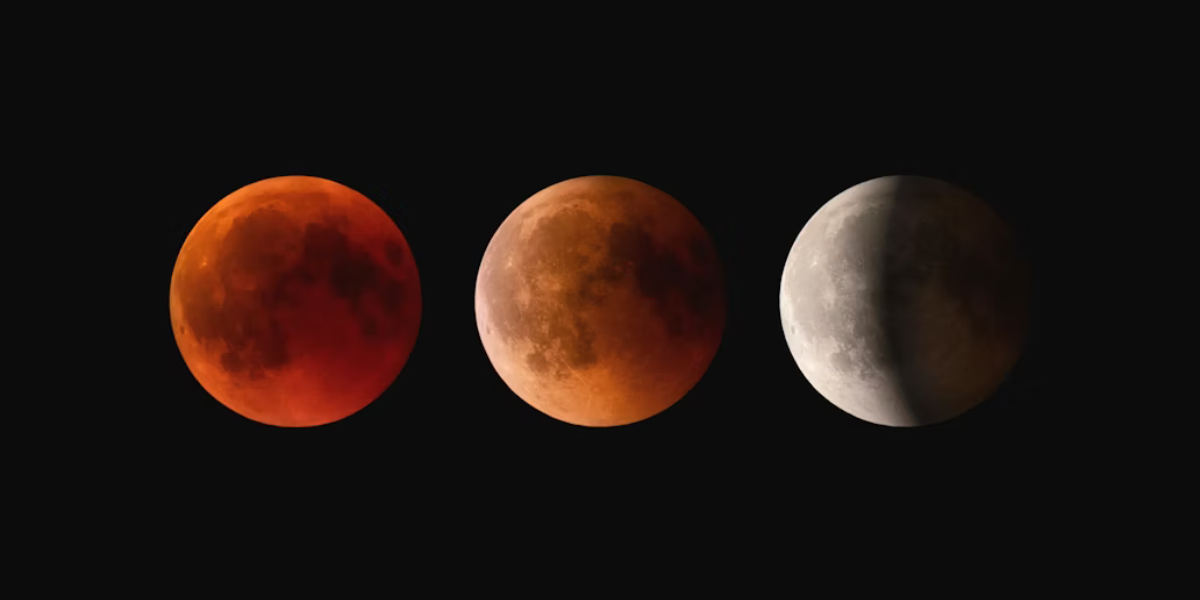
In the early morning hours of Tuesday, March 3, 2026, millions of Americans stepped outside or looked through their windows to witness one of the year’s most remarkable astronomical events: a total lunar eclipse, commonly known as a “Blood Moon.” The celestial phenomenon transformed the Moon into a striking reddish orb, offering a rare and memorable spectacle visible across much of the United States.
A total lunar eclipse occurs when the Earth moves directly between the Sun and the Moon during a full moon phase, casting its shadow across the lunar surface. Unlike a solar eclipse, which requires protective eyewear and limited geographic positioning, a lunar eclipse is safe to observe with the naked eye and can be seen by anyone on the night side of Earth. This accessibility contributed to widespread public interest, with astronomy enthusiasts, families, schools, and community organizations organizing early-morning viewing gatherings.
The eclipse unfolded in several stages. The penumbral phase, when the Moon first entered Earth’s outer shadow, began before dawn. While this stage produces only subtle dimming, the subsequent partial phase made the shadow more visible as it gradually covered the Moon’s surface. The most dramatic period, totality, occurred shortly after 6:00 a.m. Eastern Time lasted just under an hour. During this time, the Moon took on a coppery-red glow, creating the iconic “Blood Moon” appearance that has fascinated observers for centuries.
The red coloration is caused by the way Earth’s atmosphere interacts with sunlight. As sunlight passes through the atmosphere, shorter wavelengths such as blue light scatter, while longer red wavelengths bend and continue toward the Moon. Essentially, all of Earth’s sunrises and sunsets are projected onto the lunar surface at once, giving it that deep red hue. The exact shade can vary depending on atmospheric conditions, including dust and particles in the air.
Weather conditions played a significant role in visibility across the country. Regions with clear skies experienced unobstructed views, while some areas with cloud cover missed portions of the event. On the West Coast, observers needed to rise especially early to view the eclipse before sunrise brightened the sky. In many cities, local astronomy clubs hosted livestreams and educational sessions, allowing people to learn about the science behind the event in real time.
This eclipse carries additional significance because it is the last total lunar eclipse visible from the United States until 2028. While partial lunar eclipses are more common, total eclipses visible from a specific geographic location occur less frequently. That rarity added to the excitement surrounding today’s event and underscored its importance for both amateur skywatchers and professional astronomers.
Beyond its visual appeal, a total lunar eclipse also offers scientific value. Researchers can use observations to better understand Earth’s atmosphere by analyzing how light bends and filters during totality. Variations in brightness and color can provide insight into atmospheric composition and global conditions. While today’s eclipse was primarily a public spectacle, it also served as a reminder of the precision and predictability of celestial mechanics.
Culturally, blood moons have inspired myths and interpretations across civilizations throughout history. In modern times, however, the event represents an opportunity for education and connection. Social media platforms were filled with images captured by smartphone cameras and telescopes alike, reflecting a shared national experience centered on scientific curiosity and natural beauty.
For those who observed it, the March 3, 2026 total lunar eclipse offered more than just a beautiful sight. It highlighted the accessibility of astronomy and the wonder of cosmic events unfolding above us. The event required no special equipment, no travel, and no admission ticket, just clear skies and a willingness to look up.
As the Moon returned to its usual silvery glow and daylight overtook the morning sky, the brief but powerful reminder of Earth’s place in the solar system lingered. While the next opportunity for Americans to witness a total lunar eclipse will not arrive until 2028, today’s Blood Moon will remain a vivid memory for those who experienced it.