
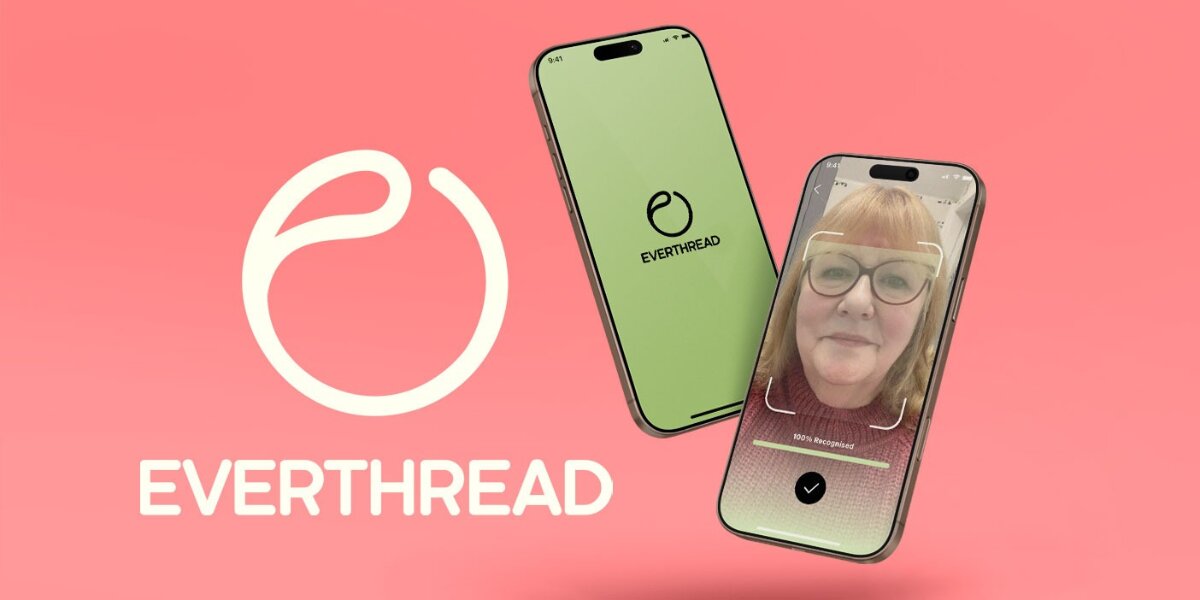
Australian-designed Everthread app, beginning clinical trials in May 2026, offers medication management and AI facial recognition for dementia.
With more than 55 million people worldwide currently living with dementia — a figure the World Health Organization projects will nearly triple by 2050 — the race to develop meaningful assistive health technology has never been more urgent. Most solutions on the market lean clinical: sterile interfaces, patronising language, and designs that treat users as patients first and people second.
Everthread, a new health app developed in Australia and set to enter clinical trials in May 2026, is taking a fundamentally different approach. The app combines AI-powered facial recognition, medication tracking, cognitive exercises, and location awareness into a single, privacy-first platform designed to help adults with dementia and cognitive decline maintain independence in their daily lives — without sacrificing dignity in the process.
How It Works
Everthread operates as a background companion rather than a clinical tool. Its core features address four of the most common daily challenges faced by people experiencing cognitive decline.
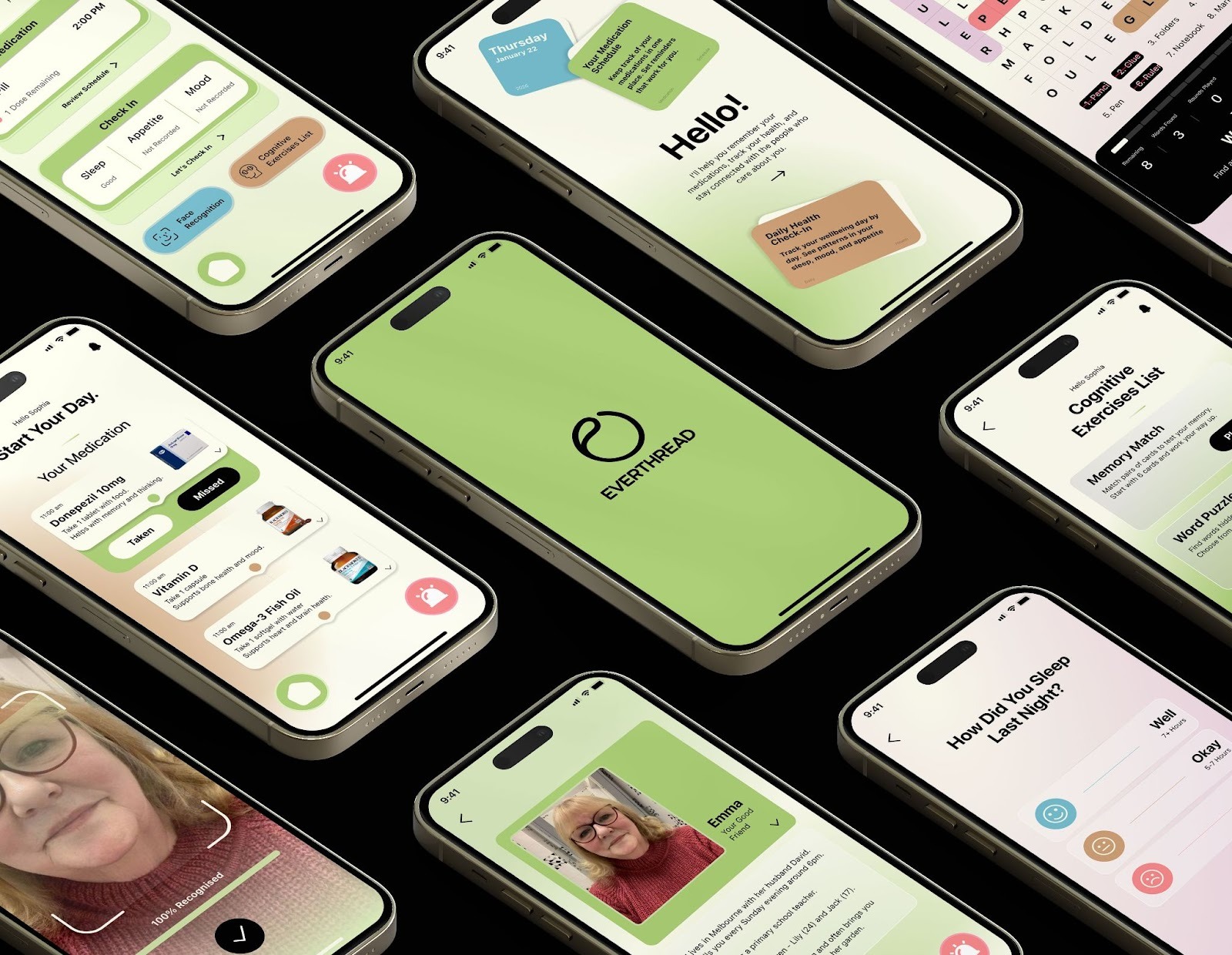
Facial Recognition uses the device camera to identify familiar faces in real time — family members, friends, carers — and displays the person’s name, relationship, and relevant personal context before a conversation begins. The feature is designed to be discreet, providing information only when needed rather than broadcasting it.
Medication Schedule organises daily medications into morning, afternoon, and evening time blocks, displaying drug names, dosages, instructions, and photographs of the actual pill packaging. The visual identification system addresses one of the most common medication errors among older adults: confusing similar-looking tablets.
Daily Health Check-In tracks three wellbeing indicators — sleep quality, appetite, and mood — through a short daily questionnaire using simple language and emoji-style response options. The data creates a longitudinal picture of the user’s wellbeing that can be shared with caregivers and healthcare providers.
Cognitive Exercises include three progressive-difficulty brain training activities — Memory Match, Word Puzzle, and Number Game — with real-time performance tracking and encouraging feedback. Unlike many cognitive training apps on the market, these exercises were designed specifically for users with existing cognitive challenges, not for neurotypical users seeking optimisation.
A companion Caregiver App allows family members and care professionals to provide support from a distance — updating contacts, receiving alerts, and coordinating care — without undermining the autonomy of the person they’re supporting.
The Design Philosophy Behind the Interface
What distinguishes Everthread from the growing field of dementia care apps is not just what the technology does, but how it looks and feels to the person using it.
The app’s brand identity, UI/UX design, and web development were created by Tokyo Design Studio Australia (TDS Australia), an award-winning design agency operating between Sydney and Saigon. The studio, which received an Honourable Mention from the International Design Awards (IDA) in 2025 and has been named one of Australia’s Best Branding Agencies by DesignRush, developed the complete visual ecosystem for Everthread — from logo and colour system to app interface, Figma design system, brand guidelines, and responsive website.
“The healthcare design space has a tendency to default to clinical blues and oversimplified interfaces that signal to users: you are a patient being managed,” says Jessica Tran, Co-Founder and Design Director at TDS Australia. “For Everthread, the brief was the opposite. Every design decision needed to answer one question — does this preserve someone’s dignity?”
The result is an interface built on warm, nature-inspired tones rather than the sterile palettes typical of health tech. The colour system — deep greens, pale olive, soft rose, natural oak, and turquoise — was chosen to evoke calm and human connection rather than clinical environments. Typography is clean and legible without being childish. The UI follows recognition-over-recall principles throughout, meaning the interface relies on visual cues and contextual prompts rather than expecting users to remember navigation paths or menu structures.
The logo design itself carries meaning: a circle intersected by a needle and thread, representing wholeness, continuity, and the active work of maintaining connections that cognitive decline threatens to unravel. The name — a combination of “ever” and “thread” — speaks to the continuous, invisible thread binding a person to their memories, relationships, and sense of self.
Privacy-First Architecture
In an industry where user data has become a growing concern — particularly for vulnerable populations — Everthread has taken a firm position on privacy. All facial recognition processing occurs locally on the user’s device. Biometric data is not uploaded to external servers, and the app does not share personal information with third-party services.
This approach aligns with a broader shift in the assistive technology sector toward on-device processing, where sensitive health and biometric data never leaves the user’s phone. For people with dementia and their families, who are often navigating complex care arrangements involving multiple parties, this kind of architectural decision matters.
A Market at a Turning Point
The global dementia care app market is expanding rapidly. Industry analysts estimate the sector was valued at approximately $250 million in 2025, with projections suggesting a compound annual growth rate between 13% and 15% through 2033. The broader assistive technology market is projected to reach $36.6 billion by 2033, driven by aging populations and advances in AI, sensor technology, and mobile computing.
What has been largely missing from this growth, according to advocates and designers working in the space, is a human-centred approach to the technology itself. Many existing apps were designed by technologists for technologists, then adapted for older adults as an afterthought. Interfaces are frequently cluttered, language skews medical, and the visual design defaults to accessibility-minimum rather than genuinely thoughtful user experience.
Everthread enters the market positioned as a counterpoint to that pattern. Its tagline — Designed for adults. Built with respect. — signals an intent to treat the user experience as fundamental to the product’s clinical utility, not secondary to it.
Availability
Everthread will begin clinical trials in Australia in May 2026, with initial testing focused on usability, efficacy, and real-world impact for people living with early to moderate cognitive decline. Pending results, additional trials are planned for the United States and United Kingdom later in the year as the team works toward broader public release. Further information, including feature details and contact information, is available at everthread.one.
The brand identity and digital design for the project were developed by Tokyo Design Studio Australia. The studio’s portfolio of brand design, web design, and creative work across healthcare, technology, and other industries can be viewed at tdsaustralia.com.au.
Media Contact:
Everthread
Email: in**@********ad.one
Tokyo Design Studio Australia
Phone: +61 420 720 992
Email: ta**@**************om.au