
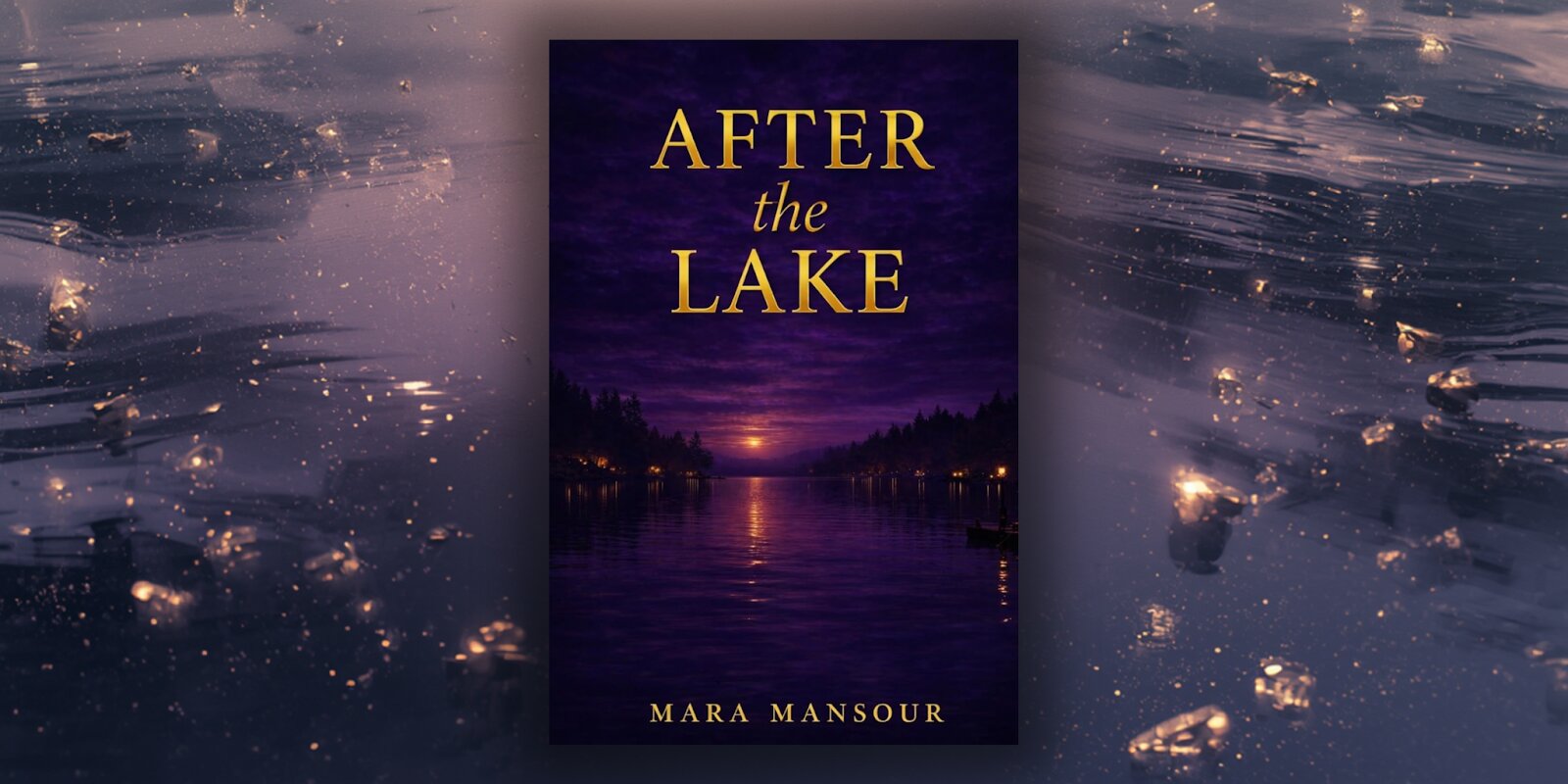
The Novel That Proves Silence Is the Most Powerful Language of All
Mara Mansour’s debut After The Lake is a slow-burn love story of rare emotional intelligence — and one of the most quietly unforgettable reads of 2026
★★★★★ Five Stars
In a literary landscape often driven by spectacle and speed, some novels choose a gentler path. After The Lake by Mara Mansour is one such debut — a reflective, slow-burning love story that lingers long after the final page.
In a world where romantic fiction thrives on dramatic twists and grand gestures, Mansour’s writing is a breath of fresh air. Her novel invites readers to slow down and appreciate the emotional subtleties that make up the quieter, more personal aspects of life. This is a story not defined by action-packed scenes, but by the emotions that unfold in the spaces between words — in the pauses and silences where characters reveal who they truly are.
A Summer That Changes Everything
There are books that entertain and books that stay with you long after the final page. Mara Mansour’s debut novel, After The Lake, is unmistakably the latter — a slow-burning, emotionally luminous love story set in late-1980s Britain that earns its place among the finest character-driven fiction published in recent years.
Mansour resists dramatic declarations. Her characters’ connection grows through lingering conversations and long afternoons that stretch into warm, possibility-filled evenings. The lake itself becomes a steady presence — calm on the surface, yet hinting at deeper currents beneath.
We don’t get a conventional meet-cute. Instead, Mansour gives us two young people separated by a social divide that neither can quite name yet both can feel. Emma is thoughtful and observant, cautious with her heart. Teddy carries his own uncertainties, unsure how to articulate feelings he barely understands. Mansour captures the fragility of adolescence with remarkable care. A glance feels monumental. A brief touch lingers. The pacing mirrors the rhythm of summer — unhurried, immersive, and full of quiet anticipation.
“Mansour is less interested in shocking turns than in the subtle evolution of her characters’ inner lives. The tension lies not in danger or dramatic twists, but in a quieter question: can love endure growth?”
Emotional Growth Over Dramatic Twists
What makes After The Lake especially touching is its focus on emotional growth rather than plot-driven spectacle. Mansour is less interested in shocking turns than in the subtle evolution of her characters’ inner lives.
When circumstances separate Emma and Teddy at the end of summer, the heartbreak is not explosive. It is quiet, almost ordinary — and therefore deeply real. Their separation becomes a turning point not because of external drama, but because of what it demands internally.
Over the following year, handwritten letters keep their bond alive. Set against the nostalgic backdrop of the 1980s, those letters feel especially poignant. There are no instant messages to bridge the gap. Every envelope carries anticipation. Every reply holds hope, vulnerability, and the risk of disappointment. The letters become a lifeline — proof that connection can survive absence, even as it changes.
Emma’s voice matures through the exchange, revealing new self-awareness. Teddy struggles with vulnerability, learning to articulate emotions he once kept guarded. Distance forces both of them to grow independently, shaping who they will be when they meet again. The suspense of the novel lies not in danger or dramatic twists, but in a quieter question: Can love endure growth? Can it survive time?
Reunion with Realism and Maturity
The novel’s second half brings reunion, the complications of trauma, and the hard work of loving someone whose wounds have changed the shape of them. A harrowing assault on Emma and its painful legal aftermath test not just the relationship but Emma herself — her sense of safety, her self-worth, her capacity to believe she deserves to be held. Mansour handles this section with extraordinary care and sensitivity, neither minimising the trauma nor allowing it to define Emma as simply a victim.
When Emma and Teddy eventually reunite, their love is no longer simple. The spark remains, but it has been altered by absence. The ease of their first summer is replaced by something more deliberate and fragile. Trust must be rebuilt. Old fears resurface alongside new uncertainties.
Mansour portrays this reunion with striking maturity. Love, she suggests, is not sustained by nostalgia alone — it requires intention, and it demands courage. Choosing each other again is no longer instinctive; it is conscious. Both characters must confront their fears: fear of rejection, fear of change, fear that what once felt effortless may now require work.
The novel also explores the invisible labor that often falls on women — the weight of family expectations, the suppression of dreams never to be pursued. Through Emma’s journey in particular, Mansour captures those quiet moments of self-sacrifice, the decision to set aside one’s own needs in order to keep life moving forward. It’s a portrayal that will resonate deeply with readers who understand the unspoken weight that comes with responsibility.

Restraint as Power
What distinguishes Mansour’s writing from much of contemporary fiction is her remarkable restraint. Her prose is lyrical yet measured — she does not overexplain emotion; she allows pauses to speak. A fleeting glance reveals more than a paragraph of exposition. The spaces between dialogue carry as much meaning as the words themselves. This trust in subtlety gives the novel its authenticity — and it is far harder to achieve than it looks.
This trust in subtlety gives the novel its authenticity. Emma and Teddy feel fully realized — flawed, hesitant, and deeply human. Their growth is gradual and believable. They question. They falter. They learn. Through them, Mansour explores vulnerability not as weakness, but as courage. She has spoken of wanting to explore love that grows in the cracks of everyday life — in small gestures, at kitchen tables and simple picnics and shared secrets. She has achieved exactly that.
Silence in this novel is never empty. It is heavy with unspoken feelings and the honesty of inhabiting complexity. For anyone who has ever struggled to articulate their emotions, After The Lake feels deeply validating. It speaks to the way many people experience life — attuned to the subtle currents surrounding them, but often unable to express them.
The dual point-of-view structure — alternating between Emma and Teddy — is handled with skill. Where Emma is watchful, guarded, always braced for disappointment, Teddy is earnest and emotionally open. Watching them teach each other is the novel’s quiet heart: Emma learning that vulnerability might not always be punished; Teddy learning that the comfortable world he grew up in has been built on other people’s losses.
A Love That Never Fully Fades
Before turning to writing, Mansour’s life encompassed a range of roles across corporate, nonprofit, education, and domestic spheres. This experience sharpened her understanding of human dynamics — the things people say, the things they leave unsaid, and the personal sacrifices that go unnoticed. That background infuses her fiction with a rare authenticity, particularly in its portrayal of women who defer their own needs for the sake of others.
Clean, thoughtful, and deeply nostalgic, After The Lake is perfect for readers who appreciate slow-burn romance and character-driven storytelling. The 1980s setting enhances this tone, grounding the story in a time when connection required patience and presence. The absence of modern distractions heightens the emotional intimacy. Waiting matters. Words matter. Silence matters.
With her debut, Mara Mansour introduces a voice rooted in emotional truth and quiet strength. After The Lake is a gentle yet powerful reminder that first love may change form, but it never truly disappears.
An Invitation to Connect
After The Lake is for those who have learned the art of patience, who know that the most meaningful connections often happen in the most ordinary moments.
If you are drawn to stories that linger, that name things you have felt but struggled to articulate, this book will feel like a gift. It will resonate especially with readers who grew up carrying adult responsibilities — who cooked dinners, managed siblings, and held households together — and with anyone who has ever wondered whether they are truly worthy of being loved.
Fans of slow-burn romance will find much to savour. There are no grand gestures or breathless reversals here. The novel is clean and appropriate for older teens as well as adult readers, and its handling of difficult themes — alcoholism, assault, class conflict — is always sensitive and thoughtful.
By the time the novel reaches its epilogue, it has earned every moment of warmth. The journey to get there has been long and honest. Which is precisely why the ending feels so deeply, quietly right.
After The Lake does not shout for attention. It whispers. And in doing so, it leaves a mark that is very hard to shake.
To learn more about Mara Mansour and her work, visit her website, follow her journey on Instagram, and explore her book on Amazon in both paperback and Kindle editions.