
Scientists and Technology Companies Commit $1.8 Billion to AI-Based Biology Research
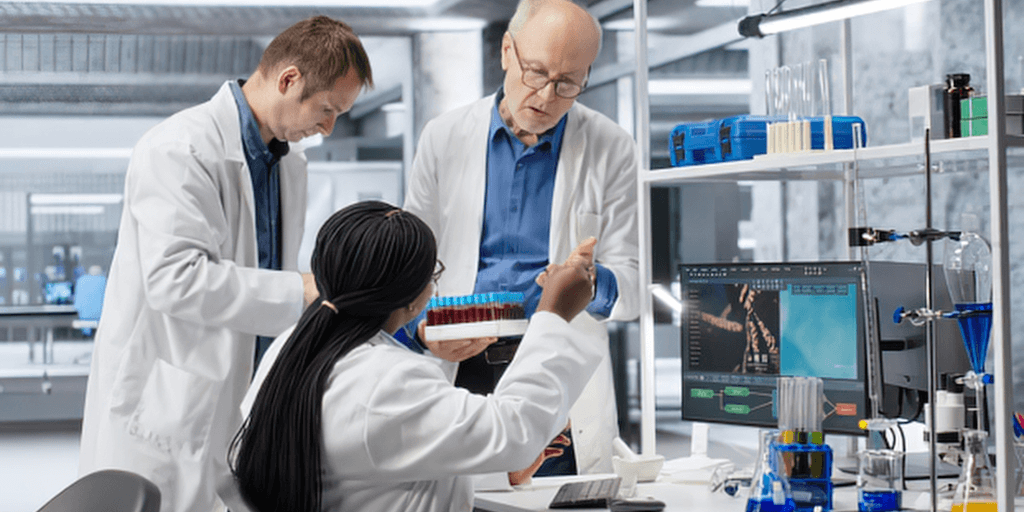
A major research collaboration aims to build the biological data needed for artificial intelligence to model cellular behavior and support disease research.
A coalition of scientific institutions, technology companies and U.S. government agencies announced a $1.8 billion commitment to artificial intelligence-driven biology research on October 7, launching an expanded effort to generate data that could help scientists predict how cells respond to different conditions.
The initiative brings together nonprofit research organization Biohub, the U.S. Department of Energy, the National Institutes of Health and private-sector partners, including Google DeepMind, Meta and Isomorphic Labs. The collaboration aims to build a large scientific data foundation for AI models that could improve researchers' understanding of biological systems and ultimately support disease research.
Why Biological Data Matter to AI
Artificial intelligence systems learn patterns from data. In biology, however, obtaining useful data can be difficult because cells are complex systems influenced by genes, proteins, environmental conditions and interactions with other cells.
A model trained on incomplete or inconsistent measurements may struggle to predict how a biological system will respond to a new intervention. Producing larger quantities of carefully measured data could help researchers investigate these relationships more systematically.
The new initiative seeks to address that challenge by generating biological measurements and making resulting datasets available to the research community. Its focus is not simply on creating another general-purpose AI assistant. Instead, it aims to build the specialized scientific foundation needed for models that represent biological behavior.
This distinction matters because a system that summarizes published medical research performs a different task from one that predicts how a cell might respond to an experimental intervention. The latter requires detailed experimental observations and rigorous validation against real biological outcomes.
What Researchers Hope to Achieve
The initiative is intended to help scientists develop predictive models of cellular responses. In practical terms, researchers could eventually use such models to explore hypotheses computationally before conducting laboratory experiments.
For example, a model might help researchers identify which experimental conditions are most promising to investigate. If validated, this approach could reduce the number of less-informative experiments and help laboratories direct resources toward questions with greater scientific potential.
However, these possibilities remain dependent on technical progress. Predicting cellular behavior across different conditions is substantially more complex than recognizing patterns in conventional digital information.
A model's usefulness will depend on the quality of its training data, the biological systems represented and its performance when tested against independent observations. Computational predictions cannot by themselves establish that a treatment is safe or effective.
The initiative therefore represents an investment in research capability rather than evidence that new treatments have already resulted from the collaboration.
Public Agencies and Private Companies Join Forces
The partnership combines capabilities that are distributed across different organizations. Biohub contributes biological research infrastructure, while the Department of Energy brings scientific computing and laboratory resources. The NIH contributes biomedical research expertise and data resources.
Technology companies add AI capabilities and computing expertise. The organizations' combined commitment includes funding, data, computation and measurement technology, according to Biohub's announcement.
This structure reflects a growing recognition that scientific AI requires more than powerful processors. It also requires specialized datasets, reliable measurement methods and cooperation among researchers who understand the underlying science.
Large-scale collaboration may allow institutions to develop resources that would be difficult for individual laboratories to assemble independently. At the same time, coordinating different organizations introduces questions about data standards, access rules, governance and independent evaluation.
Those issues will be important in determining whether the resulting resources become broadly useful scientific infrastructure.
Open Data and Access Questions
Biohub has described the initiative as an effort to create an open resource for scientific research. The arrangement includes an initial period of exclusive access for commercial partners before datasets are made available more broadly.
The timing and terms of access matter because the value of a scientific dataset depends partly on whether researchers outside the original partnership can use it. Universities, smaller laboratories and independent research groups may benefit from shared resources that would otherwise require substantial investment to produce.
Open access alone, however, does not guarantee reproducibility. Researchers will also need information about how measurements were collected, which conditions were studied and how models were trained and evaluated.
Independent testing will help establish whether models can make reliable predictions beyond the experiments used to develop them.
A Long-Term Scientific Test
The initiative's significance lies in its attempt to address a fundamental bottleneck in computational biology. If researchers can develop more reliable ways to model cellular behavior, the resulting tools could support a wide range of investigations into disease and biological processes.
But the announcement does not establish that those outcomes have been achieved. The effort must still demonstrate that the datasets are sufficiently comprehensive, that models make accurate predictions and that the results improve experimental research.
For the public, the development offers a view of how AI is moving beyond familiar applications such as text generation and image creation into specialized scientific work. The potential benefits may be substantial, but they will depend on evidence gathered through research rather than on the scale of the financial commitment alone.
The central question is whether the collaboration can turn a large investment in data and computing into reproducible scientific insights. Its progress will be measured not simply by how much information it generates, but by whether that information helps researchers understand biological systems more accurately.

Good Morning US Contributor
Covers world affairs and science, connecting research and foreign policy to the readers they affect.
This article features partner, contributor, or branded content from a third party. Members of the Good Morning US editorial staff were not involved in the creation of this content. All views and opinions are those of the contributor alone.
You May Also Like

Kully Bath: A Voice for the Unseen

Diana Sussman Unveils The Texter’s Secret, Her Latest Maddie Mystery

Michael J. Bannach: The Most Expensive IT Plan Is the One Without an Agreement
Michelle Bishop: Choose You First and Thrive

Oliver Happy Hour: Siblings on AI and Humanity