
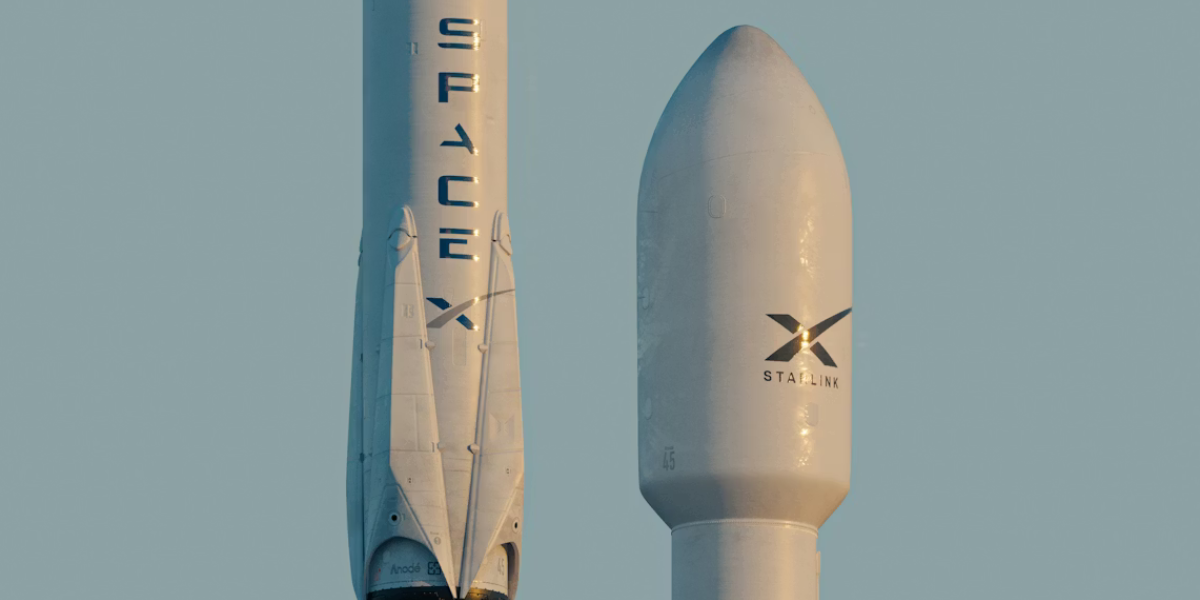
The United States marked another milestone in commercial spaceflight today as SpaceX successfully launched a Falcon 9 rocket carrying a new batch of Starlink satellites into low-Earth orbit. The mission, conducted from Cape Canaveral Space Force Station in Florida, reflects the continued expansion of satellite-based internet infrastructure and highlights the country’s leadership in private-sector space operations.
The Falcon 9 rocket lifted off from Space Launch Complex 40 in the early hours of the morning, carrying 29 Starlink v2 mini satellites. These satellites are designed to enhance the capacity and performance of SpaceX’s rapidly growing Starlink constellation, a global network intended to provide high-speed, low-latency broadband service to users around the world, particularly in underserved and rural areas.
Today’s launch also demonstrated the reliability and reusability of SpaceX’s hardware. The Falcon 9 first-stage booster used for the mission completed its 26th flight, underscoring the company’s success in refurbishing and reusing rocket components. After separating from the upper stage, the booster executed a controlled descent and successfully landed on an autonomous droneship stationed in the Atlantic Ocean. This routine yet technically complex maneuver significantly reduces launch costs and turnaround times, making frequent missions more economically viable.
The Starlink program, first initiated in 2019, has grown into one of the largest satellite constellations in history. With thousands of satellites already in orbit, the network serves millions of customers across multiple continents. Each additional launch strengthens the system’s overall performance by improving coverage density, boosting data capacity, and lowering latency. The newly deployed satellites are equipped with advanced features that allow more efficient communication and greater bandwidth, helping meet rising global demand for reliable internet connectivity.
The significance of today’s launch extends beyond technical achievement. Satellite internet has become increasingly critical in bridging digital divides, particularly in regions where traditional fiber or cable infrastructure is limited or cost-prohibitive. In the United States, rural communities, emergency response teams, and mobile users in remote areas have benefited from satellite-based connectivity. Globally, similar services provide communication lifelines during natural disasters and humanitarian crises when ground-based networks are disrupted.
The mission also reflects the broader momentum within the U.S. commercial space industry. Launch activity from Florida and California has increased steadily in recent years, with private companies playing a central role in satellite deployment, cargo transport, and research missions. This consistent cadence of launches reinforces the United States’ position at the forefront of space innovation and technology development.
Public interest in the event was notable, as residents along parts of the East Coast were able to witness the rocket’s ascent. Under clear conditions, the bright exhaust plume was visible in the pre-dawn sky across several states, offering a rare opportunity for skywatchers to observe a live orbital launch. Such events continue to capture the imagination of the public and inspire interest in science, technology, engineering, and mathematics (STEM) fields.
Looking ahead, SpaceX is expected to continue its regular launch schedule throughout the year as it builds out the Starlink constellation. The company has also indicated plans to enhance satellite capabilities, including improved direct-to-device communication features and expanded service options. As demand for data connectivity grows worldwide, satellite networks are poised to play an increasingly central role in global communications infrastructure.
Today’s Falcon 9 mission illustrates how routine launches are becoming part of the modern technological landscape. What once represented rare and extraordinary achievements has evolved into a steady operational rhythm, driven by advancements in engineering and manufacturing efficiency. For consumers, businesses, and communities that rely on dependable internet access, each launch represents tangible progress toward a more connected world.
In summary, the March 2, 2026, Falcon 9 launch stands as a testament to American innovation in aerospace and telecommunications. By successfully deploying another set of Starlink satellites and demonstrating reusable rocket technology, SpaceX continues to shape the future of commercial spaceflight and digital connectivity.